Healing through movement: research on Capoeira Angola
By: RAYQUAN HANKINS
Feb 23, 2026
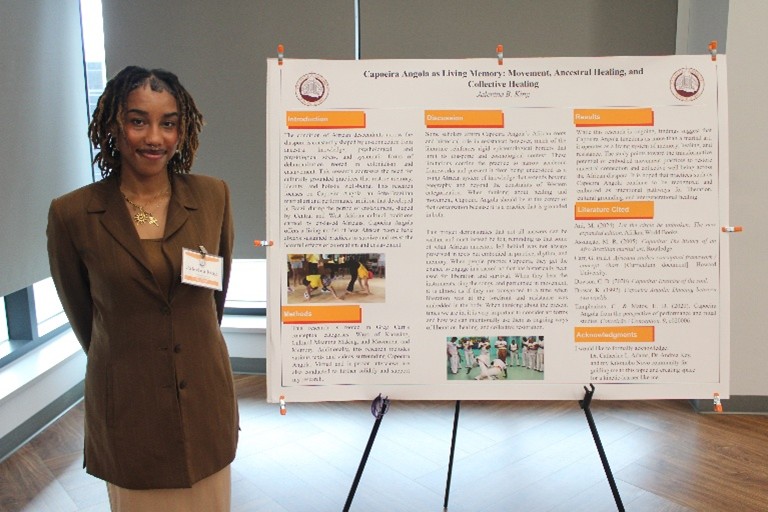
The ballroom on the third floor of the Student Center was buzzing. Students stood beside research posters while classmates and faculty moved from table to table. Conversations overlapped. Laughter and footsteps filled the room.
Then Jalevina King asked everyone to raise their hands.
At first, there was confusion. Some of us looked at each other. A few laughed.
“Everybody, raise your hand,” she said with a smile.
Phones and notebooks were quickly set down. It felt almost like a competition. Students joked, “Oh, I’m ready,” as they prepared to mirror her movements.
“I can’t talk about movement without actually making y’all move,” King said. “I just want y’all to be present.”
Even in a crowded ballroom, her voice carried. The noise faded as she guided the room through a short mirroring exercise -- grounding everyone in the moment before the research even began.
More than a martial art
King, an African and African American Studies major with a minor in psychology, presented “Capoeira Angola as Living Memory: Movement, Ancestral Healing, and Collective Healing.” Her research explores how Capoeira Angola — an Afro-Brazilian martial art created by enslaved Africans — helps people reconnect with culture, identity and history.
“They would play in front of the master,” King explained. “It looked like a game, but they were training.”
She emphasized that the practice was more than physical movement. It was a way to preserve culture when so much was stripped away.
“The condition of African descendants across the diaspora is shaped by disconnection,” she said. “There was a lot of trauma, and we’re still feeling it.”
“It’s not just a martial art,” King said. “It’s memory. It’s healing. It’s resistance.”
Healing you can feel
Not all knowledge comes from books, King said. “Some things can’t just be written down. You have to feel it.”
She shared a personal story about trying to recreate her late mother’s macaroni and cheese during the holidays.
“I had the recipe,” she said. “But it didn’t feel the same. I had to stop and really remember how she did it.”
That moment revealed how memory can live in the body, not just on paper.
Movement and community
This year’s Research Day theme centered on Ujima, meaning collective work and responsibility. King connected her research to that idea, showing that healing isn’t just personal — it can be shared.
“When people come together to practice, sing, and move, it creates something bigger than the individual,” she said.
She challenged students to reflect on their own movement. Basketball. Tennis. Dance. Students shared what they do, reinforcing her point that movement exists in everyday life.
“You don’t have to practice Capoeira to experience that connection,” King said. “Culturally grounded movement can go a long way.”
By the end of her presentation, the ballroom was still buzzing with conversations, but the group around her poster felt focused and intentional.
Before she explained her research, she asked us to move. By the end, we understood why.