Orangeburg Massacre: committed to a lasting legacy
By: MYAH BURT
Feb 20, 2026
(Panther photo by Myah Burt)
“Remembrance is not a ritual, it is a responsibility,” the 2026 Orangeburg Massacre commemoration guest speaker emphasized to the audience.
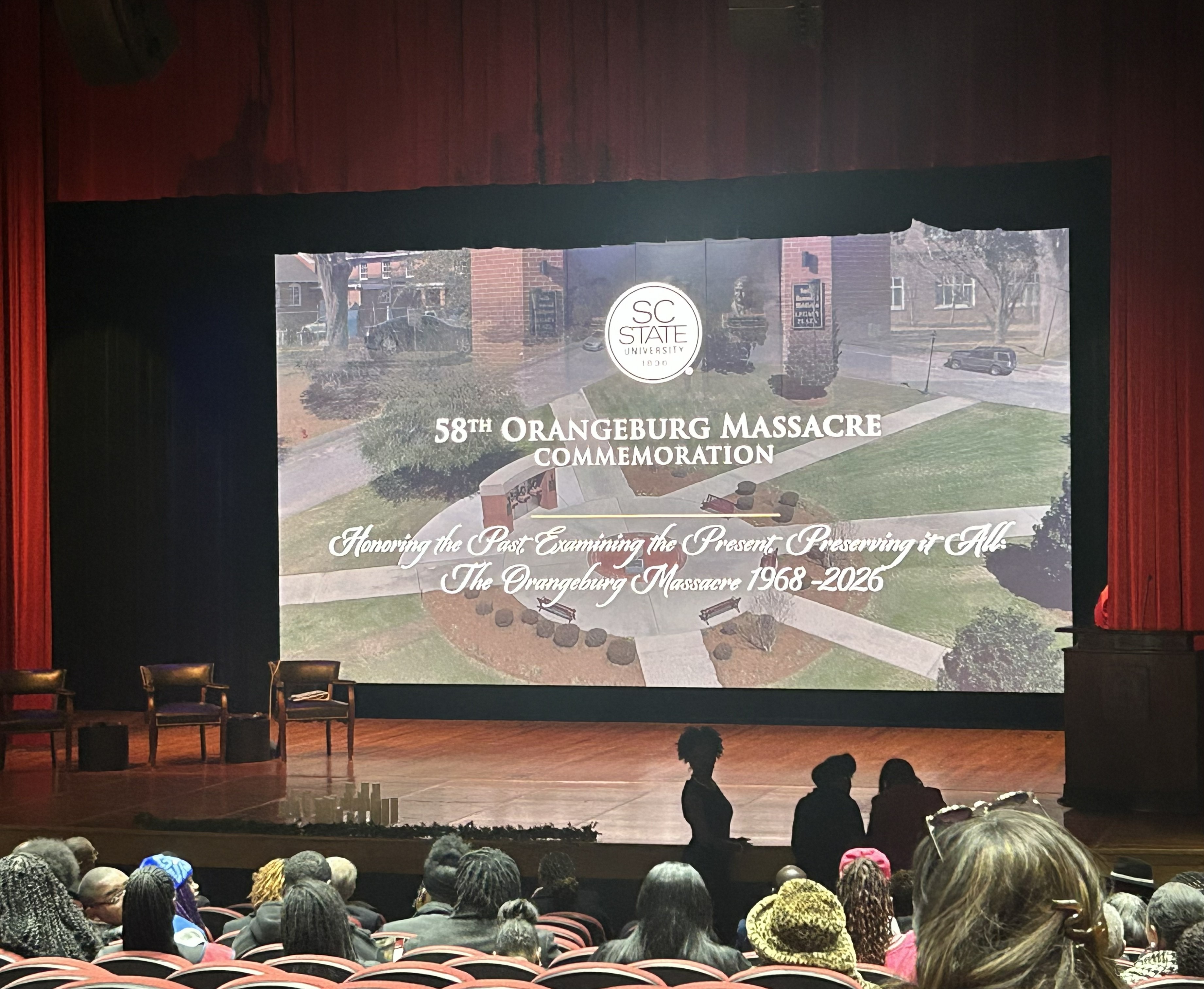
Michael A. Allen, a South Carolina State University alumnus and community activist, spoke at the 58th annual ceremony held on Feb.8, the anniversary of the1968 incident during which unarmed students protesting segregation were shot by highway patrolmen at the entrance of S.C. State. Twenty-eight were injured and three young men were killed.
“This tragic event would mark the first time in American history that students were killed by law enforcement officers on a college campus. Let that truth settle in on us,” Allen said.
This year the theme was “Honoring the Past, Examining the Present, Preserving it All.” Students, faculty, alumni, families of the victims and more gathered to honor the legacy of Henry Smith, Samuel Hammond Jr. and Delano Middleton, the three killed on Feb. 8, 1968.
Reflecting on the victims, Allen proclaimed, “They were not criminals. They were not insurgents. They were young people standing on the right side of the law, the right side of history, standing on business.”
Cleveland Sellers, a victim who became the only person arrested in the wake of the shooting, was in attendance. Sellers served jail time on a riot charge but was later pardoned by the state.
Allen addressed his strength.
“I thank you sir for your service, your friendship, our comradery. And though you spent some time in a different place in a different attire, you came back stronger. Though you may have received a pardon in this process, your star never went out.”
Allen also addressed the family members of the three deceased young men.
“Please know this. Your loved ones are not forgotten. Their legacy is not erased. Their sacrifice was not in vain. Scripture tells us that ‘weeping may endure for a night, but joy cometh in the morning.’”
During the ceremony it was announced that the bowling alley on S.C. State's campus would reopen that day after being closed for years.
Former President M. Maceo Nance built the facility to honor the fight of past students at All Star Bowling Lanes in Orangeburg. Desegregating the Russell Street bowling alley was a focus of protesting students in 1968.
S.C. State President Alexander Conyers spoke at the ceremony.
“It wasn't just about bowling. It was about the right to bowl if they wanted to bowl,” Conyers said. “It was about them fighting for others who wanted to bowl.”
He added, “The system doesn't always get it right and it is up to us to overturn every rock, every stone, to find when the system gets it wrong. That we fix it.”
Each year at the ceremony, social justice awards are given to those who have made great impacts in the Orangeburg community. This year the four winners were guest speaker Allen, Barbara Johnson Williams, L. Zimmerman Keitt and Lenell Geter.
Geter faced a tragedy of his own. After graduating from S.C. State in 1982, Geter was falsely accused of an armed robbery in Texas and sentenced to life in prison. After national outrage, he was later exonerated after serving 16 months in prison.
“I am here today, no criminal record, because God became involved,” Geter said. “We have to remember this [Orangeburg Massacre] occasion. It is so important for the next generation. When you think of your legacy, think of those who will be coming after you.”
Williams, a proud leader in the NAACP, also added an inspiring message.
“Keep marching, keep fighting, for we are not there yet. I've been in the battlefield for a long, long time, and I'm not tired yet.”
Other highlights of the ceremony included musical performances by the S.C. State concert choir and relatives of Middleton.
After the ceremony, attendees walked to the Smith-Hammond-Middleton Legacy Memorial Plaza for the laying of the reefs and the lighting of the memorial flame.
Allen left all attendees with a newfound mission.
“Generations who will find themselves at this university will learn their names, know their names, say their names, and understand their courage. Let us leave here today, committed, not only to remember, but to justice, truth, and a moral courage in our own time.”