Claflin University’s Entrepreneurship and Ecosystems Program Provides Students Insight into Career Preparation and Business Development
Feb 11, 2026
Claflin University launched a new Digital Entrepreneurship and Ecosystems Program designed to strengthen workforce readiness, expand experiential learning opportunities, and position the University as a regional hub for digital innovation. The program, which launched in Fall 2025, is led by Henry Ideozu, director of Entrepreneurship and Digital Ecosystem Programs. and is supported through a grant from the National Telecommunications and Information Administration (NTIA).
The inagural program officially began on September 9, 2025, and will continue through February 28, 2026. While this initial cohort represents the first implementation phase, the initiative is intentionally structured as a long-term, scalable program aligned with Claflin University’s broader mission to integrate academic excellence with career preparation and economic development.
Rooted in experiential learning, the Digital Entrepreneurship and Ecosystems Program provides students with hands-on opportunities to apply digital tools, entrepreneurial thinking, and collaborative problem-solving to real-world challenges. The program is open to students across all academic disciplines, reinforcing the belief that innovation is not confined to a single field of study.
“The goal is to cultivate an entrepreneurial mindset within a digital ecosystem,” said Mr. Ideozu. “Regardless of major, whether science, business, social sciences, or the arts, students are encouraged to think creatively, collaborate effectively, and develop solutions that address real problems in today’s technology-driven economy.”
During the Fall semester, student teams successfully completed the Problem Statement phase, identifying business and community challenges, defining stakeholder needs, and establishing a clear foundation for applied research. With the start of the Spring semester, the program has transitioned into the Research phase, where participants are conducting market analysis, customer discovery, feasibility studies, and behavioral research to inform solution development.
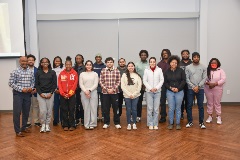
From approximately 25 applicants, six interns were selected based on demonstrated digital proficiency, problem-solving ability, and teamwork. Participants represent a diverse range of academic disciplines, including computer science, business, marketing, art, and social sciences.
Students collaborate closely with faculty advisors, student consultants, and three limited liability companies (LLCs), including both student-led ventures and local small businesses. Each LLC works with multidisciplinary consulting teams to identify operational challenges, define pain points, and develop creative, human-centered solutions that integrate technology and business strategy.
“The strength of this program lies in its ability to merge technology with human insight,” Ideozu added. “Technical skill is essential, but equally important is the ability to communicate, collaborate, and understand the people and communities being served.”
The program also benefits from strategic partnerships with the Orangeburg County Chamber of Commerce, enabling participants to earn professional certifications that validate their digital competencies for the workforce. In addition, the initiative collaborates with Rowdy Orbit, which supports experiential learning through digital platforms and innovation frameworks that enhance applied learning and entrepreneurial execution.
All participants receive laptops to support their learning throughout the program, which they may retain upon successful completion. While six interns receive stipends, all students gain invaluable professional experience, industry exposure, and access to networks that extend beyond the classroom.
The Digital Entrepreneurship and Ecosystems Program reflects Claflin University’s long-term commitment to workforce development, experiential education, and community engagement. By embedding real-world problem-solving into the student experience, the University continues to prepare graduates who are adaptable, innovative, and ready to lead in an evolving digital economy.
“The objective is not simply to teach technical skills,” Ideozu reiterated. “It is to empower students to see themselves as creators, innovators, and digital leaders prepared for the workforce of tomorrow.”